TWO: BREAKING INTO THE MIDST OF THE ENEMY'S LINES, THE "BELLEISLE" WAS SURROUNDED ON ALL SIDES.... RAKED FORE AND AFT AND THUNDERED AT FROM ALL QUARTERS, EVERY MAST AND SPAR OF THE GALLANT "SEVENTY-FOUR" WAS SHOT AWAY, HER HULL KNOCKED ALMOST TO PIECES, AND THE DECKS CUMBERED WITH DEAD AND DYING. STILL THE UNEQUAL FIGHT WENT ON, TILL AT LAST THE "SWIFTSURE," BURSTING THROUGH THE M¨ºL¨¦E, PASSED CLOSE UNDER THE STERN OF THE BATTERED WRECK, GIVING THREE HEARTY CHEERS WHEN A union JACK WAS WAVED FROM A PIKE TO SHOW THAT, THOUGH CRIPPLED THE "BELLEISLE" WAS STILL UNCONQUERED.¡ªAn Incident at Trafalgar."The Clare election supplied the manifest proof of an abnormal and unhealthy condition of the public mind in Ireland¡ªthe manifest proof that the sense of a common grievance and the sympathies of a common interest were beginning to loosen the ties which connect different classes of men in friendly relations to each other, to weaken the force of local and personal attachments, and to unite the scattered elements of society into a homogeneous and disciplined mass, yielding willing obedience to the assumed authority of superior intelligence hostile to the law and to the Government which administered it. There is a wide distinction (though it is not willingly recognised by a heated party) between the hasty concession to unprincipled agitation and provident precaution against the explosion of public feeling gradually acquiring the strength which makes it irresistible. 'Concede nothing to agitation,' is the ready cry of those who are not responsible¡ªthe vigour of whose decisions is often proportionate to their own personal immunity from danger, and imperfect knowledge of the true state of affairs. A prudent Minister, before he determines against all concession¡ªagainst any yielding or compromise of former opinions¡ªmust well consider what it is that he has to resist, and what are his powers of resistance. His task would be an easy one if it were sufficient to resolve that he would yield nothing to violence or to the menace of physical force. In this case of the Clare election, and of its natural consequences, what was the evil to be apprehended? Not force, not violence, not any act of which law could take cognisance. The real danger was in the peaceable and legitimate exercise of a franchise according to the will and conscience of the holder. In such an exercise of that franchise, not merely permitted, but encouraged and approved by constitutional law, was involved a revolution of the electoral system in Ireland¡ªthe transfer of political power, so far as it was connected with representation, from one party to another. The actual transfer was the least of the evil; the process by which it was to be effected¡ªthe repetition in each county of the scenes of the Clare election¡ªthe fifty-pound free-holders, the gentry to a man polling one way, their alienated tenantry another¡ªall the great interests of the county broken down¡ª'the universal desertion' (I am quoting the expressions of Mr. Fitzgerald)¡ªthe agitator and the priest laughing to scorn the baffled landlord¡ªthe local heaving and throes of society on every casual vacancy in a county¡ªthe universal convulsion at a general election¡ªthis was the danger to be apprehended; those were the evils to be resisted. What was the power of resistance? 'Alter the law, and remodel the franchise,' was the ready, the improvident response. If it had been desired to increase the strength of a formidable confederacy, and, by rallying round it the sympathies of good men and of powerful parties in Great Britain, to insure for it a signal triumph, to extinguish the hope of effecting an amicable adjustment of the Catholic question, and of applying a corrective to the real evils and abuses of elective franchise, the best way to attain these pernicious ends would have been to propose to Parliament, on the part of the Government, the abrupt extinction of the forty-shilling franchise in Ireland, together with the continued maintenance of civil disability."
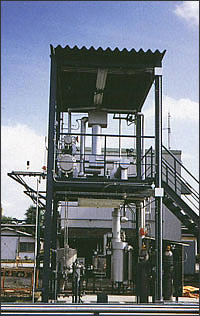
Great attention is recently being paid to global environmental issues, and it is now conceivable that companies will need to treat used solvents themselves. In consideration of this kind of social issue, we have developed a “membrane separation type solvent dehydration system,” which uses a polyimide membrane with superior dehydration properties developed by Ube Industries, Ltd. in combination with our own distillation and concentration technology that has resulted in solvents being more easily recovered.
THREE:It was quite evident that a Ministry assailed in this manner, and left almost without defenders in Parliament, while the public out of doors were so excited against them that no act of theirs could give satisfaction or inspire confidence, could not long remain in office. Accordingly, they made up their minds to retire on the first opportunity. Three important questions stood for discussion, on any one of which they were sure to be defeated. The Duke selected the question of the Civil List. In the Royal Speech his Majesty surrendered the hereditary revenues of the Crown to the disposal of Parliament. The Opposition could see no merit in that, and Lord Grey contended that those revenues were not private but public property, assigned by the State for the purpose of maintaining the dignity of the Sovereign, and that from this purpose they could not be alienated. The debate came on upon the 12th of November, when the Chancellor of the Exchequer moved that the House do resolve itself into committee on the Civil List, the scheme which he had brought forward fixing the amount to be settled at ¡ê970,000. Several of the details in this scheme were objected to, and on the following day Sir H. Parnell moved, as an amendment to the resolutions of the Chancellor of the Exchequer, that a select committee be appointed to take into consideration the estimates and accounts printed by command of his Majesty regarding the Civil List. After a short debate the House divided, when the numbers were¡ªfor the amendment, 233; and against it, 204, giving a majority of twenty-nine against the Government. Mr. Hobhouse immediately asked[324] Sir Robert Peel whether Ministers intended to retain office after this expression of the sentiments of the House. To which he gave no answer at the time; but the next day the Duke in the Upper House, and Sir Robert in the Lower, announced that they held their offices only till their successors were appointed. The defeat was brought about, in a great measure, by the former supporters of the Ministry. The blow was struck, and none recoiled from it more immediately than the section of angry Tories who were mainly instrumental in delivering it. They had achieved their purpose, and stood aghast, for no time was lost with the Duke in placing his resignation in the hands of the king.
- 1Under the distillation system, even in case of azeotropic solvent compositions, this system which remove water vapor by the polyimide membrane will easily dehydrate.
- 2In comparison with the distillation system, it significantly saves on use of steam.
- 3Dehydration can be performed through merely supplying evaporated vapor to the membrane module and maintaining the differential pressure between the permeable side and the impermeable side.
- 4Solvent purity of 99.9% or more can be achieved by carrying out dehydration with a polyimide membrane only.
- 5The polyimide membrane has superior heat and solvent resistance. Therefore, the vapor permeation system reduces contamination of the membrane and thus extends its life.
THREE:
The aromatic polyimide membrane is highly permeable to water vapor but less permeable to vapors of organic compounds such as alcohol etc.
THREE:The great philosopher of this period was John Locke (b. 1632; d. 1704). Locke had much to do with the governments of his time, and especially with that extraordinary agitator and speculator, Ashley, Lord Shaftesbury, whom he attended in his banishment, and did not return till the Revolution. Yet, though so much connected with government, office, and the political schemers, Locke remained wonderfully unworldly in his nature. His philosophical bias, no doubt, preserved him from the corrupt influences around him. He was a staunch advocate of toleration, and wrote three letters on Toleration, and left another unfinished at his death. In these he defended both religious and civil liberty against Jonas Proast and Sir Robert Filmer, advocates of the divine right of kings. His "Thoughts on Education" and his "Treatises on Government" served as the foundations of Rousseau's "Emile" and his "Contrat Social." Besides these he wrote numerous works of a theological kind, as "The Vindication of the Reasonableness of Christianity;" and in his last years, "A Discourse upon Miracles," "Paraphrases of St. Paul," and "An Essay for the Understanding of St. Paul's Epistles;" a work "On the Conduct of the Understanding," and "An Examination of Father Malebranche's Opinion of Seeing all Things in God." But his great work is his "Essay concerning the Human Understanding." This may be considered the first pure and systematic treatise on metaphysics in the English language; and though the pursuit of the science since his time has led to the rejection of many of his opinions, the work will always remain as an able and clearly-reasoned attempt to follow the method of Bacon in tracing the nature and operations of the understanding.
- 1 Recovery of the detergent solvent Recovery of the cleaning solvent such as electronic parts industry, precision instrument industry.
- 2Solvent recovery and the refinement Solvent recovery and the refinement such as chemical industry, an industry of medical supplies, food industry, the fermentation industry.
THREE:The campaign against the French was opened in February by Prince Ferdinand of Brunswick attacking the Duke de Broglie, and driving him out of Cassel. Prince Ferdinand followed up this advantage by attacking them in Marburg and G?ttingen, and applied himself particularly to the siege of Cassel. But Broglie, now recovered from his surprise, first defeated the hereditary Prince of Brunswick, Ferdinand's nephew, at Stangerode, and then repulsed Ferdinand himself from Cassel.
Acetone, ethanol, methyl ethyl ketone, butanol, isopropyl alcohol, ethyl acetate, methyl isobutyl ketone, others (including hexane and toluene).
